Building Systems That Actually Work: Our New Management System Framework
Most management systems are built for giant corporations with dedicated compliance teams and endless resources. If you're a small business, startup, or grassroots organization, those frameworks feel impossible to implement—like trying to fit a cruise ship engine into a speedboat.
We built something different.
The Problem With Traditional Management Systems
Here's what usually happens: A small business owner realizes they need better systems. They look up "management frameworks" and find ISO standards, Six Sigma methodologies, or complex enterprise systems that require full-time staff just to maintain them.
So they either:
Try to implement something way too complex and give up halfway through
Wing it with no system at all, creating chaos as they grow
Waste money on consultants who don't understand their reality
None of these options work. And meanwhile, the business suffers—new employees don't know what to do, quality becomes inconsistent, and growth creates more problems than opportunities.
What Makes Our Approach Different
We created a management system with 10 core processes specifically designed for organizations at any size and maturity level. Whether you're a solo entrepreneur planning to scale or a 50-person company trying to bring order to chaos, these processes grow with you.
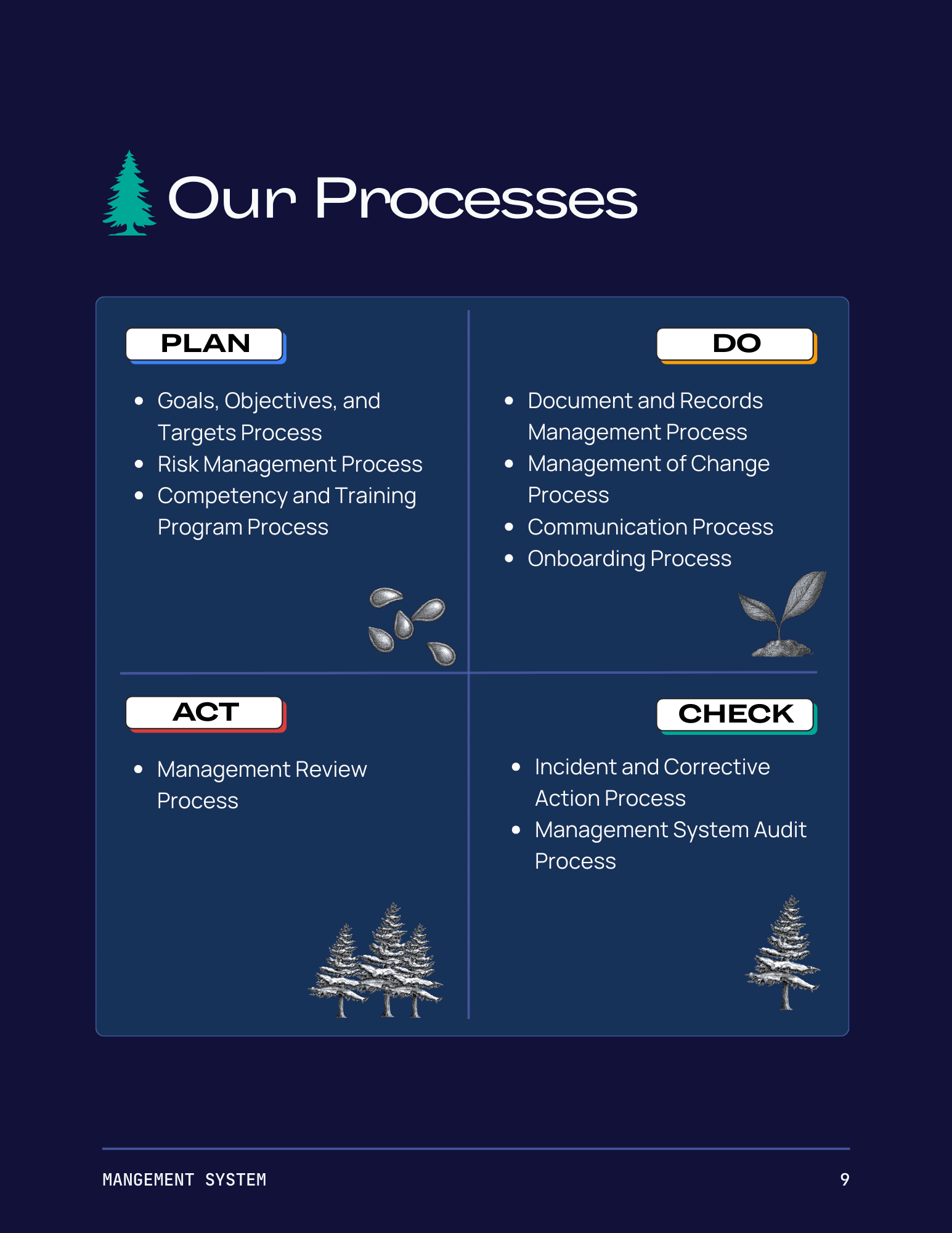
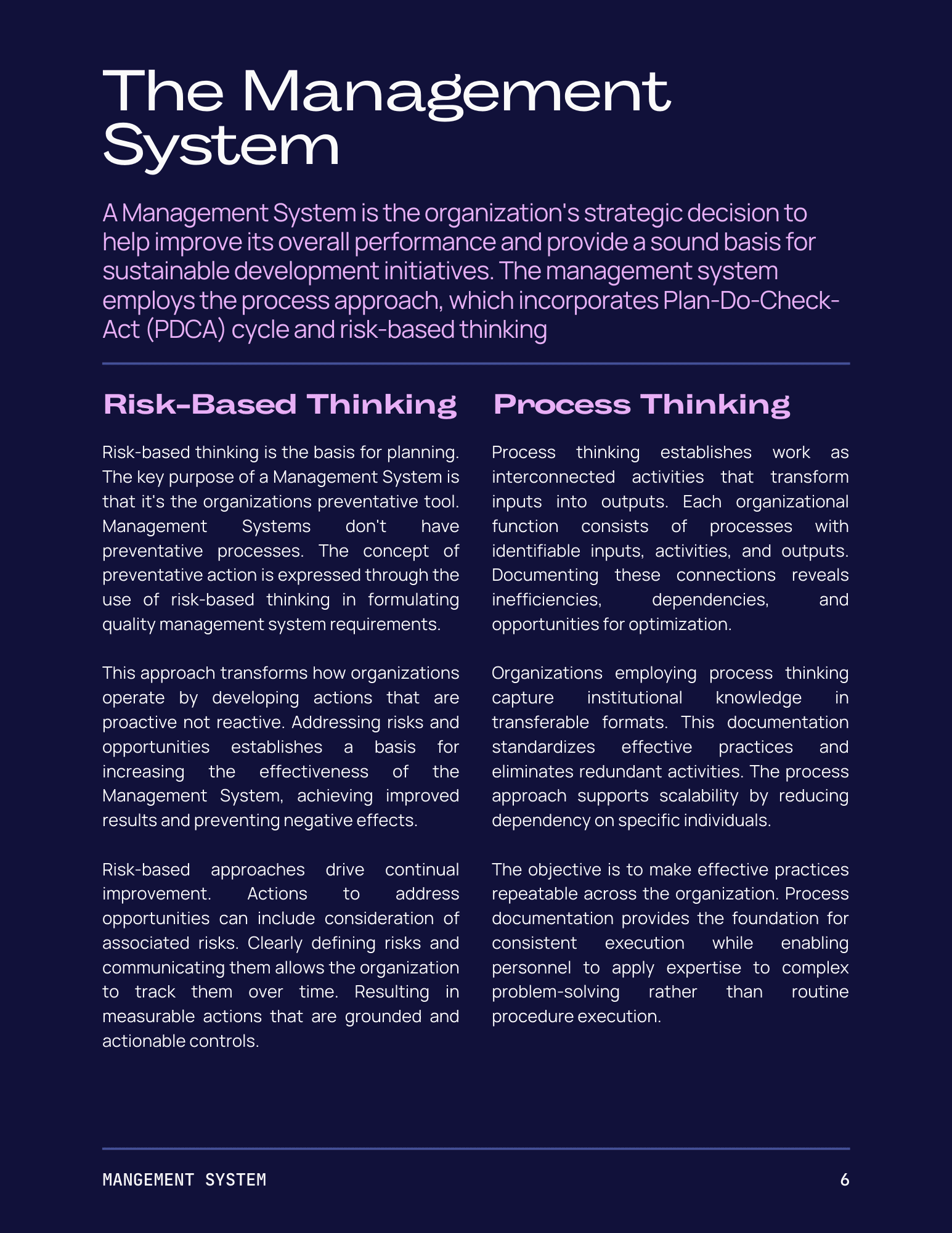
The framework is built around Plan-Do-Check-Act (PDCA) cycle and risk-based thinking—the same foundations that power successful organizations worldwide—but stripped down to what actually matters for smaller operations.
Our 10 Core Processes:
PLAN Phase: |
|
DO Phase: |
|
CHECK Phase: |
|
ACT Phase: |
|
Each process is designed to be implemented at whatever level makes sense for your current reality. A three-person startup will use these processes differently than a 30-person company—and that's exactly the point.
Why These 10 Processes?
We didn't pick these randomly. These are the fundamental systems that every organization needs to function well, regardless of size:
Without clear goals, you're just busy without being productive.
Without risk management, you're constantly firefighting instead of preventing problems.
Without training processes, every new hire is a gamble.
Without document management, critical information lives in people's heads or gets lost in email chains.
Without change management, improvements create chaos.
Without communication processes, teams work in silos.
Without onboarding systems, new people take months to become productive.
Without incident tracking, you keep making the same mistakes.
Without audits, you don't know what's actually working.
Without management reviews, you're steering blind.
From Seeds to Forests
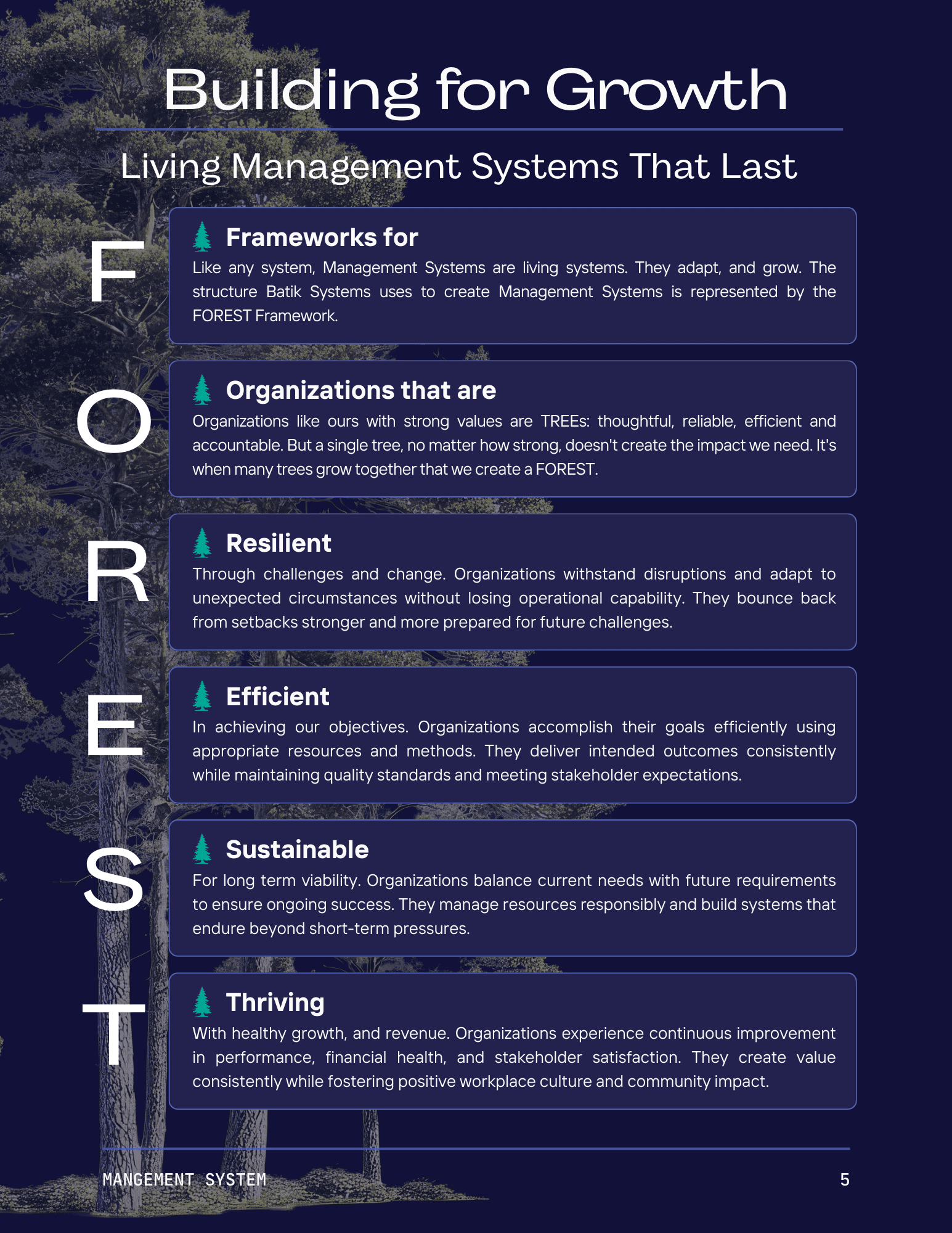
We use a tree metaphor because it captures how these systems work:
Seeds = Your initial processes (PLAN phase)
Sprouts = Implementation and daily operations (DO phase)
Growing trees = Monitoring and verification (CHECK phase)
Forest = The mature, resilient organization you're building (ACT phase)
When you plant seeds (set goals, identify risks, train people), those sprouts become daily operations. As they grow, you check their health through audits and incident tracking. Eventually, your collective work creates a forest—a resilient framework for your organization that can weather storms and continue growing.
Real-World Application
Here's what this looks like in practice:
Startup phase: You might have simple one-page documents for each process—just enough structure to stay organized without bureaucracy.
Growth phase: Those processes expand with templates, checklists, and clear ownership as more people join.
Maturity phase: Your system becomes sophisticated with integrated tools, automation, and continuous improvement built in.
The beauty is you don't need to figure out what comes next—the framework guides you through natural evolution as your organization grows.
It's About Building, Not Just Compliance
Most management systems exist to satisfy auditors or regulators. Ours exists to make your business actually work better.
Yes, if you need to meet specific standards (ISO, industry regulations, etc.), this framework supports that. But more importantly, it helps you:
Onboard new people faster
Maintain quality as you scale
Prevent problems before they happen
Keep institutional knowledge when people leave
Make better decisions with clear data
Build something sustainable
Getting Started
The best part? You don't have to implement all 10 processes at once. Start with the 2-3 that address your biggest pain points right now. Build from there.
Most organizations find that Risk Management, Goals/Objectives, and Communication processes give them the biggest immediate impact. But your situation might be different—and that's fine.
Quality, Discernment, and Wisdom
These three principles guide everything we build at Batik Systems. Quality means doing things right. Discernment means knowing what matters. Wisdom means understanding how to achieve it.
This management system framework embodies all three: quality processes that actually work, discernment to focus on what's essential, and wisdom drawn from years of implementation across industries.